








Plant of the month - Cyclamen coum
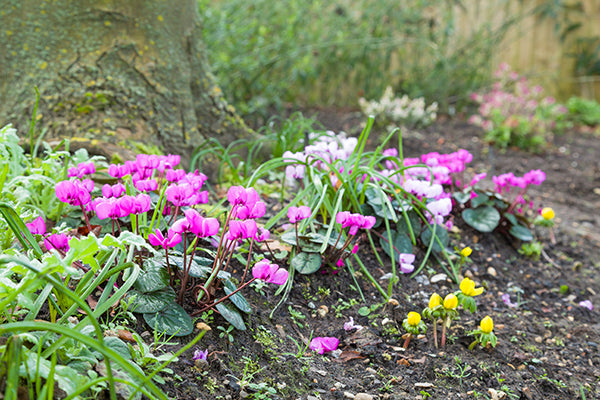
There’s something magical about the way cyclamen lie dormant in warm weather, appearing again when temperatures drop. Despite their dainty appearance, they bloom through frost and snow and, in the right location, will freely self-seed and carpet the ground.
Flowering from late December, Cyclamen coum have rounded, dark green leaves with white or silver markings which appear first before the flowers. It’s the other way round with autumn flowering Cyclamen hederifolium where the flowers appear before their striking marbled leaves ivy-shaped leaves.
The flower of Cyclamen coum tend to be magenta pink, but also come in a range of pinks to pure white. More unusual varieties include C. coum subsp. Coum f. coum ‘Pewter Group’ which have a silvery coating on the leaves or C. coum f. albissimum ‘Ashwood Snowflake’ with pure white flowers.
These cyclamen like partial shade and humus-rich, well-drained soil - avoid manure as they like poorer soils and this will just produce leaves and no flowers if the soil is too rich. Instead, dig in grit or leaf mould if you have heavy soil. They also like dappled shade and moisture in autumn through to spring, which is when they grow below ground - long before they emerge.
These tiny cyclamen look wonderful in large groups, and are perfect for naturalising around the base of deciduous trees - they look stunning under silver birch and are gorgeous with snowdrops, crocuses and other shade lovers such as ferns. Tempting as it is, avoid planting C. hederifolium and Cyclamen coum together, as the former is more vigorous and will eventually take over.


